
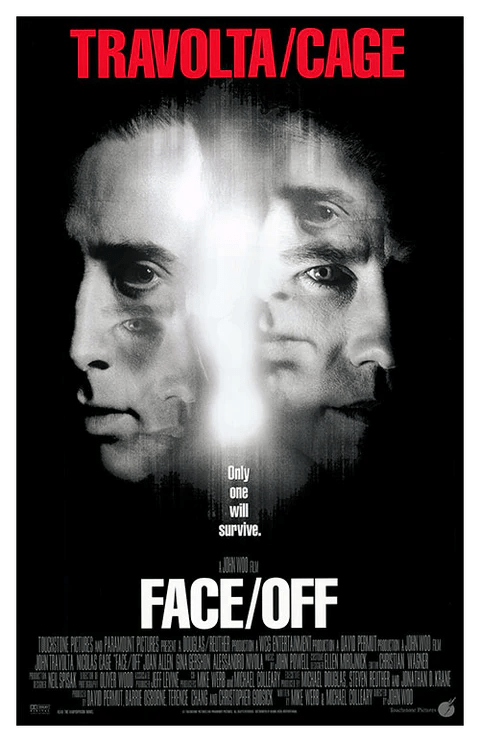
John Woo’s textbook hyperstylization is present from the moment the movie opens to an extent that it isn’t in any of his others. There is no shyness or slow burn when it comes to his chaotic expression, no pretense of subtlety – every camera movement, edit, line and cinematographic choice is amplified and exaggerated to a comic extent. Even the plot is cartoonish, totally hinging on the conceit that two men could undergo an operation to switch faces without anyone being any the wiser. And in 1997, no less! No two actors could have been better-suited to the material than Nic Cage and John Travolta. Though many pairs were considered (including the all-too-serious coupling of Al Pacino and Robert De Niro), the level of melodrama and downright silliness that Woo and the camp script call for could only be reached by actors as untethered to a thespian norm as these two. Moreover, the casting as to who plays who is a stroke of genius. Cage, who at first appears to be typecast as the villain, ends up playing the hero when the character’s faces are swapped, and Travolta, often pigeonholed as a suave hero, sees the opposite as a cruel antagonist, each actor subverting our expectations as the style subverts a typical action film’s.
Their mutual complete commitment to the wild, explosive bit allows not only for duels of ultratheatrical one-liners and gestures, but also incredible physical bouts. The kinetic camerawork and intricate choreography create brawls that feel intense and spontaneous, despite the unseriousness framing them. Woo is one of the few action directors who can perfectly balance exciting direction and visual clarity, the push-and-pull of any action setpiece. A static shot held for too long freezes the excitement, but a blurry handheld shot obscures a viewer’s perception of the action from moment to moment, either mistake risking the viewer being unable to invest and immerse themselves in a scene. Woo can somehow always tow the line perfectly, one of the many reasons he’s an all-time master of the genre. His use of slow motion especially, which he moves in and out of with astonishing fluidity, has become an overused staple of studio action. Here, we can see why it became so popular in the hands of an expert.
As much respect is due to his craft, not all the praise can go to Woo. Face/Off credits twenty-two people for their work on its stunts, a list that’s pretty much a who’s-who of Hollywood action choreography. Also of note are the twenty-one sound designers, recorders and editors who helped add the luscious auditory depth to Woo’s bombastic atmosphere. Echo and reverb in particular are used to great effect, creating a layered web of sound that stretches across the entire movie.
Most faults are to be found in the screenplay. Chief among the story’s many flaccid details is the inclusion of protagonist Sean Archer’s many interchangeable friends at the FBI. These characters are all without personalities, only written as props by which to measure Archer’s virtue. He is repeatedly shown respecting and conversing with them as equals, in stark contrast to how antagonist Castor Troy berates and belittles them in his place. However, Archer’s wife and child, and Troy’s criminal accomplices, are used for this same purpose, making many scenes feel redundant. Another waste of the film’s runtime is a subplot in which Archer has his wife compare his blood samples with Troy’s to prove who is who – she could have come to the same conclusion through shared memories or a heartfelt conversation, anything more personal and cinematic. Archer also has an inexplicable habit of running his hand down the faces of those he is close to as a show of love. While this doesn’t infringe on or affect the story, it’s highlighted so much that it becomes distracting in its lack of apparent motivation.
The screenplay’s errors and holes, though many, ultimately have little bearing on the viewing experience. Woo uses a skillful eye for movement and a sharp balance of tone to make what is truly a ridiculous story feel somehow plausible and even ironically intellectual.
 Jaxon Safian's Film Reviews