
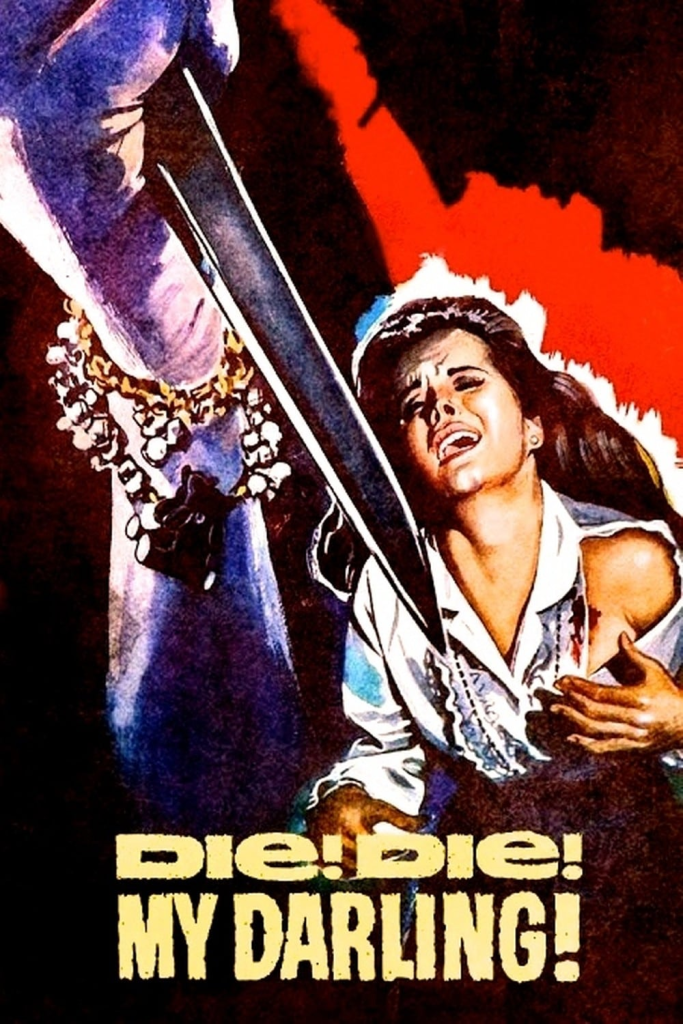
Die! Die! My Darling, released in the U.K. under the significantly less awesome title Fanatic, is among my favorite suspense films of its time. Blending handheld camerawork reminiscent of its contemporary exploitation films with Hitchcockian cinematography, it strikes an unsettling nerve in the grey area between classic thriller and illicit grindhouse pulp. While on the surface, it may appear to be nothing more than another bland 60s drama, Die! Die! My Darling hides a more complex true form, a vision of a world rotting with patriarchal repression and the ruined matriarch(s) who hold it up.
DDMD follows the newly widowed Patricia, already engaged to another man just months after the loss of her previous fiancé, the cruel and abusive Stephen, to suicide. She visits Stephen’s religious mother in London to pay her respects, only to become trapped in the house when the mother, Mrs. Trefoile, discovers that Patricia has not remained faithful to Stephen in his death. What follows is a taut thriller as Patricia makes repeated attempts to escape from Mrs. Trefoile and the married couple she employs, Harry and Anna. However, none of the women in this story, including the villainous Mrs. Trefoile, ever maliciously bring harm on one another; all the conflict and turpitude inflicted upon them is at the hands of men, albeit often indirectly.
Harry is a womanizer, attempted rapist, and all-around abuser who uses his privilege to exploit the less fortunate around him. He is shown to be controlling of his wife, Anna: Anna feels guilty about working for Mrs. Trefoile, and about helping her kidnap Patricia, but is forced to continue by Harry, upon whom she is financially dependent. The both of them are only employed because Harry is a relative of the Trefoiles, so if he were to quit, his wife would likely be fired. He holds this above her head, threatening her when she complains of his cheating or drinking. Past this emotional abuse, he attempts to rape the kidnapped Patricia when he thinks Mrs. Trefoile is asleep, an action so abhorrent that Mrs. Trefoile kills him for his ungodly ways.
If Harry represents the immediate wrongdoings perpetrated by men, God represents the system of power that protects them. His image of superiority, and the outdated, often sexist rhetoric associated with certain religious practices and hierarchies, corrupt Mrs. Trefoile against her fellow woman, manipulating her into shaming and eventually torturing Patricia for her expression of femininity, perceived promiscuity, and retaliation against abusive men. As the story progresses, God’s thematic position as the ultimate patriarch is filled narratively by Stephen, Mrs Trefoile’s dead son. She believes all the crimes she is committing against Patricia will help cleanse Stephen’s soul and grant him entrance to heaven, and towards the third act, she even begins hearing him speak. When Mrs. Trefoile eventually decides that the word of God demands Patricia be killed, she prepares to kill Patricia before a giant painting of Stephen. He looks down upon the both of them with judgement in his eyes as a sacrifice is laid before him, like a statue of Kronos. In this climactic scene, Stephen takes the place of God, both in terms of the plot, and in the eyes of his mother.
Patricia is eventually saved from Mrs. Trefoile when her fiancé, who is implied to have been verbally abusive, finds her – but, back under the control of another man, she remains victim to the influence that turned Mrs. Trefoile against her. Before she is “rescued,” however, Patricia, her fiancé and Anna all get into an altercation with Mrs. Trefoile, who defends herself with a knife. While at first it appears the fight has caused no serious injury to anyone, the last shot of the film shows us that Mrs. Trefoile, crumpled on the ground beneath her painting of Stephen, has been killed by her own knife, lodged deep in her back. The narrative cliffhanger of the film is the question of who stabbed her, a question to which no literal answer is clear nor relevant. Her killer, symbolically speaking, was Stephen, a murder of holy intervention. Stephen, by now a representation of the worshipped face of patriarchal power, rises to the power of a god and kills his own mother when she fails to uphold his will and persecute the women around her. God may be dead or outmoded, but the patriarchy isn’t going anywhere.
 Jaxon Safian's Film Reviews