
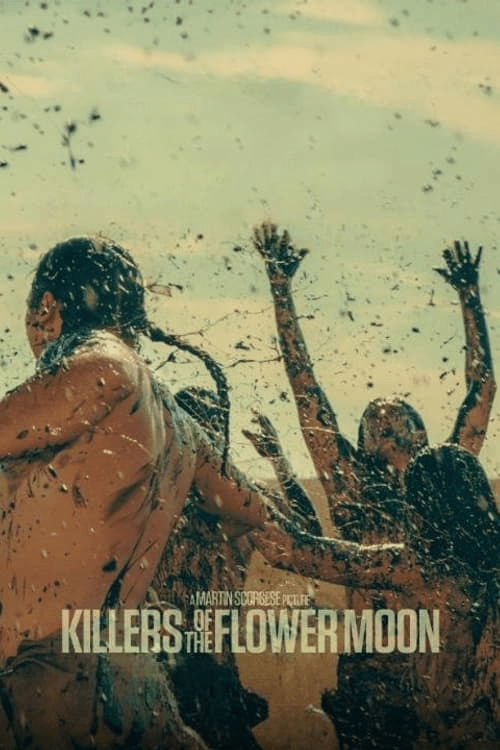
Killers of the Flower Moon is the first Martin Scorsese picture I’ve ever seen in a theatre, and though I’ve never been particularly spiritual it felt to me like a religious experience. The way he moves the camera, how Schoonmaker combines his shots, how loud noises are contrasted with utter silence, it all felt truly transcendental. Part of this feeling, however, may be due to the somewhat airy nature of the film, how open its gaps are. Running at three and a half hours, the simplistic true crime plot is bogged down by lengthy scenes of plotting and planning, leaving little room for emotion. As if to add to this, the characters are all rather flat and two dimensional.
Despite the blandness of the roles, Scorsese’s fantastic cast delivers a myriad of spellbinding performances, so convincing that critics are praising the writing for its realism and complexity, two elements it most certainly lacks. Leonardo DiCaprio as the naïve Earnest Burkhart, who rolls over and obeys his conniving Uncle Hale’s every command, is able to switch on a dime between panic at the thought of his crimes being discovered to guilt at the knowledge of what he has done. In one stand-out scene, he looks upon the wreckage of a house that has been blown to bits as per his request (a request made by his Uncle’s instruction, of course) and fears that the victims may still be alive. One is, but is dying, and begging to be put out of his misery, and the other has had her head blown apart. His visually legible transition from frantic anxiety to relief, then to fabricated shock, and finally to shame at the realization of his heinous actions is entirely fluid. Rarely can it be accurately said that an actor disappears into a role, but here it is completely true; a mix of facial acting and prosthetic work around his cheeks, lips and teeth make him appear as a totally new individual, comparable to Marlon Brando’s appearance in The Godfather. His suggestible disposition is reminiscent of Robert De Niro’s morally aloof portrayal of Frank Sheeran in Scorsese’s previous film, The Irishman. Here, De Niro is the surprising dud of the cast as the aforementioned Uncle William Hale, and while the performance he delivers is by no means weak, he takes no liberties with his one-note, mustache-twirling antagonist.
As many predicted upon the release of the trailer, Lily Gladstone is the stand-out star of the film. Her confident, self-aware Mollie, who veils her outrage in outbursts of grief when she cannot control it, is a unique take on a victim character – she knows, to a certain extent, that she is being taken advantage of, but she doesn’t see any other path for herself, and walks into her fate with a bravery bordering on, but never quite reaching, stoicism. When she falls deathly ill amidst a series of murders, we can see her fear even in her near-comatose state. This state, to me, was the cardinal sin of the movie; while it isn’t a flaw from a narrative standpoint, it robs Gladstone, the film’s greatest aspect and shining light, of more screen time, an absence sorely felt in the arduous third act.
It’s one of those movies wherein every moment seems so purposeful, yet looking back I cannot imagine how the story lasted so long, and was so convoluted. I am unsure whether it is the fault of the editing, the script, my own incompetence or some combination of the three, but I found it near impossible to follow certain subplots, which, though I may be wrong, seem to have been played out of order both individually and in relation to each other. Frankly, I wouldn’t have a problem with this form of storytelling if I knew for certain whether or not it was intentional. As it stands, the disconnectedness of the plotting feels unpurposeful, and thereby confusing.
It is somewhat shocking to me that Scorsese has chosen another story of this shallowness; his last foray into such thematic simplicity was Silence, which I chalked up to its personal relevance to his life and beliefs. Here, as with Silence, the movie’s stance on what it depicts is rather black-and-white, with clear good guys and bad guys, clear wrong and right. A film of this magnitude should be layered, and a film of this simplicity should not have such magnitude – the two traits are simply incompatible. I have a long-held conviction when it comes to narrative at large, that a lengthy parable is a waste of an audience’s time. As applicable as that is here, I cannot bring myself to wholly dismiss the picture as message-based, to dismiss any Scorsese picture as message-based, because his cinematography, and his camerawork, and his editing, and just every aspect of his craft is so exact and so perfect that I cannot help but sit back and marvel at it in awe. He’s a man who could make drying paint compelling, who can motivate me to watch anything he creates. I will never not watch a Martin Scorsese picture, and I will never not love it. I only hope he continues his increasing use of gore.
 Jaxon Safian's Film Reviews