
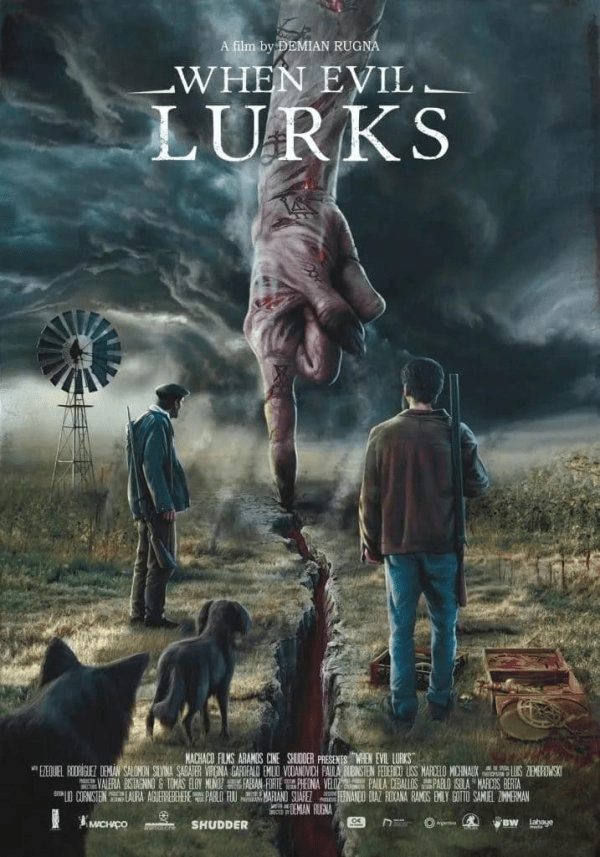
There’s a lot I don’t like about When Evil Lurks. The story doesn’t do it for me, and I was never in very much suspense, or especially creeped out. There are some uses of CGI that were very obvious and could have easily been replaced by practical effects, and much of the visual direction relies too heavily on the narrative focus and ignores the rest of the frame, which becomes a barren wasteland where pixels go to die. Perhaps the most potent misstep, describing the mind of an autistic person as a “limbo” in which a demon can become lost is quite the choice. Despite all this, the sheer brutality of the film was enough to keep me enthralled. I’ve always said that I respect a horror movie that’s willing to kill pre-pubescent children on screen, and regardless of this film’s shortcomings, for that and a variety of other reasons, I respect it. It’s a shame that recognizing its audacity is the highest praise I can give, that I wouldn’t consider the movie as being of significant technical or emotional or narrative quality, but I certainly enjoyed myself while watching it, and it certainly garnered my admiration. A lot of times, I’ll watch a movie that I’m not crazy about and wonder how any creative could be passionate about working on it, given the amount of time, energy and love a movie takes to make. This is not one of those movies. I understand the intent, and I appreciate the effort put forth, and I’m so pleased that it connected with other people in a way it didn’t for me.
That said, I do have a fair share of criticisms of the film that warrant discussion. First and foremost, the rules are inconsistent, which is a cardinal sin for any fantasy or sci-fi story. Most notably, the rule that electric light is dangerous is used to move the story forward in key moments, but ignored when an unimportant prop is electronic. Even in the house of a possession-experienced woman who claims to never use electric lighting, there are lamps and book lights and even a night projector in the backgrounds of certain rooms. In one scene, the characters scramble over a flashlight, borrowed from the very same woman who supposedly sees exclusively by flame and the light of day. Another of these supposed rules is that clothes worn in close proximity to the possessed are to be burned, but after the first set of clothes are burned, none of the characters so much as change, even after talking to and touching the possessed, and nothing ever comes of this. Furthermore, the importance of the rules overall is unclear. All we are told is that they must be followed if one wishes to “stay safe” around demons, but what happens if they are broken is not made explicit, which muddies the tension and makes the fact that these rules are being disregarded by the script all the more infuriating. It seems to me that the intention was to keep the threat of the possession vague, a device used to great effect in countless horror films (my personal favorite example being the found footage Hell House LLC), but is here sabotaged as the screenplay tries to have its cake and eat it too by developing a half-baked system of survival amongst the characters. The minutiae of the supernatural certainly should have either had more time in the oven, or been stripped down to their bread and butter, cookie-cutter horror elements so that the plot and characters could take a front seat. As it stands, the plot and characters are sidelined in favor of these frivolous, overlapping fictional laws of demonology.
The protagonist, Pedro, played expertly by Ezequiel Rodríguez, is at first the only person to see reason. We see the story through his eyes, and watch people die when they don’t follow his advice. As the film goes on, however, and he becomes more personally affected by the possessions, his sense of reason disintegrates, and he also begins to make mistakes that cost lives. This is a very interesting character arc, one that I was excited to follow as it revealed itself, but I became quickly disappointed – it is always made abundantly clear to the audience what is the right and wrong thing to do, so as Pedro’s assuredness falters, we see him less as a man who has undergone trauma losing his way, and more as a bumbling buffoon who has suddenly stopped seeing what is right in front of him. His actions become frustrating, like those of so many horror protagonists, and though his arc is objectively full, and, I daresay, completed well, it is not as satisfying as it might be from a storytelling standpoint that we are not in on the experience. His brother Jimmy, played not very expertly by Demián Salomón, is a skeptic, but is forever loyal and willing to go along with whatever Pedro says. At first, this appears unjustified, but his motivation is revealed in the third act. The reveal is an effective ‘Ah, so!’ moment, but leaves Jimmy feeling false the entire first hour. It’s like the character equivalent of the Hitchcock bomb-under-the-table discussion; it would be better to sacrifice the few moments of shock, so that the dynamic could be established from the start and thereby color our vision and understanding of the film as a whole. Perhaps this would be a less glaring flaw if Salomón was pulling his weight – he has a constantly perplexed look about him, which, while certainly realistic for a person living through a supernatural apocalypse, doesn’t exactly make for a gripping viewing experience. His performance’s trademark is to stare off into the distance over the shoulder of another character who is talking to him, as if analyzing the wall behind them. The look on his face is so unchanging that I am suspicious Salomón might be under the impression that he has found some sort of all-purpose expression, which encapsulates every emotion necessary of an actor. He most certainly has not.
The film is one created with clear themes and messages, that are unfortunately not expounded upon. The characters are defined, but, with the exception of Pedro, not developed. Even the plot, a meandering affair with the structure of a hangout movie, leads nowhere, and gets there very slowly, through a series of meetups and liaisons strikingly reminiscent of Christopher Nolan’s tendency to exposit by taking us to a place that lets us know we need to go to another place, where someone lets us know we need to meet with someone else, who tells us nothing is as it seems. This kind of second-third-fourth-hand storytelling is becoming more and more prevalent, and it’s a form of presenting information to the audience that I don’t have much patience for. For fans of When Evil Lurks, I strongly recommend The Dark and The Wicked, which is a very similar, but in my opinion far superior film. Still, I wouldn’t disincentivize anyone from watching When Evil Lurks; though I didn’t personally enjoy it, I can see what it has to offer, and the fervor with which it does so.
 Jaxon Safian's Film Reviews