
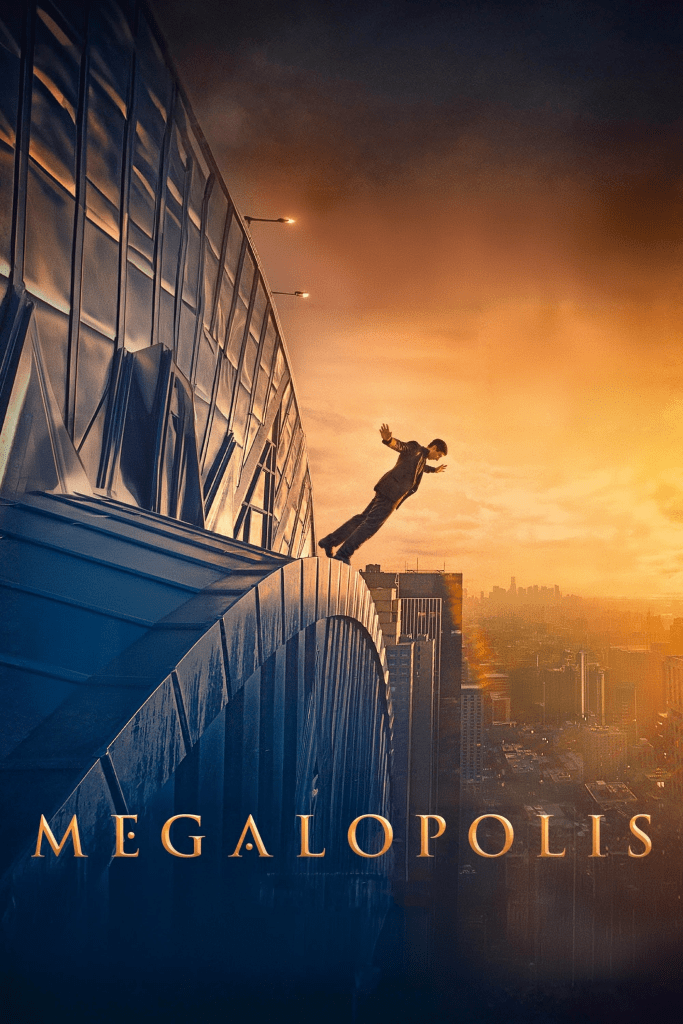
The first thing that struck me about Megalopolis, Francis Ford Coppola’s first film in thirteen years (there’s a Dementia 13 joke in there somewhere – Megalopolis is a viewing experience that had me questioning the possibility of Coppola’s senility) and I hope the last of his career, was its constant and overbearing sexism. I’ve heard this described as an undercurrent, but it is in no way subtle; I’ve heard it described as commentary on sexism, but commentary must go farther than practice. These two elements, a crushing lack of subtlety and an insistence that its faults are inherent self-commentary, plague the movie. Despite its fledgling expressionist imagery, ever-obvious but never cogent, Coppola’s self-described ‘fable’ is so blatant in its ideas that the knee-jerk reaction will be to consider them in satire, as laughable break-downs of themselves – yet here, Coppola is, if nothing else, being genuine. I kept returning, to maintain my sanity while watching, to the idea of art as a documentation of an artist’s state of mind – if this can be taken as any indication, Coppola is seriously disturbed.
Before I continue, I should mention my bias. I have, for a number of years, been a detractor of FF Coppola’s; to use a trending expression, I’ve been praying on his downfall. Though I have a great admiration for The Conversation, and a begrudging fondness for his adaptation of The Outsiders (although Matt Dillon’s contribution there cannot be overstated), I generally find his direction and especially his writing cold and unfeeling. In addition to that rather hot take, I have, in the process of writing an essay on the codependent rape culture of Hollywood, researched the skeletons in his closet extensively, and found myself, even by the horrific standards of auteurs, appalled. I won’t take it upon myself to compile my findings here – I respect those that would rather not know so as to avoid such bias – but I must note that he has a terrible pattern of defending, both verbally and financially (and on occasion legally), some of the film world’s worst sexual offenders. I bring this up not only to illustrate my own misgivings walking into this movie, but because it unfortunately has great bearing on the movie’s events, as I’ll get into more down the line. I don’t want to plunge into the weeds of separating art from artist (a journey from which few ever return, with glazed-over eyes and a pinky cut off in sacrifice to the altar of Polanski), but as I alluded to with the concept of art as self-documentation, Megalopolis is explicitly autobiographical, and thus such a separation is in my view impossible, and moreover distracts from Coppola’s own points. So as this review continues it will be examining the film through the lens of its director…sorry. However, bias aside, I truly approached Megalopolis with hope – I hoped it would push boundaries, I hoped it would be the shot in the arm the film world needs right now. And maybe it is a shot in the arm, but not the one I expected: a glaring announcement of who behind the camera has all the power, even away from the studio system and even with self-financed projects (because to self-finance a movie of this scale you need to be incredibly wealthy in the first place), and why they need to give it up or have it stripped from them.
Back to the film. Megalopolis has been in the works for some four decades and change, apparently scrapped and reworked and set aside repeatedly as Coppola’s career took its dramatic dives and flights, yet still the story is up in the air; the set has been described as ‘improvisation-heavy,’ not only in terms of the liberties the actors were allowed to take but also in Coppola’s formulation of plot. The mind boggles – forty years in the making, and the story was created on the fly. If it came to a semi-cohesive product, this would be astoundingly impressive, but it really does watch as being both over- and under-cooked, both over-elaborated and trivialized. As I learned more of the context of its creation after watching, the only response I could bring myself to was, ‘yeah, that makes sense.’ Scenes are cut together haphazardly, clearly with pieces missing, often substituted with CGI and extremely blatant ADR (those moments when an actor turns their head away from the camera and we hear a line that’s been dubbed in) – my deepest sympathies go out to editor Glen Scantlebury (I cannot fathom how a single person smashed all this footage – and digitally-rendered non-footage – together), who worked previously with Coppola on Bram Stoker’s Dracula and The Godfather Part III, and who is clearly being asked to weave gold from Coppola’s scraps of nothing. He does his best. Even Coppola’s crew seem at a loss for what on earth he was spending his time doing on set: one anonymous crewmember is quoted in The Guardian as recalling, “He would often show up in the mornings before these big sequences and because no plan had been put in place, and because he wouldn’t allow his collaborators to put a plan in place, he would often just sit in his trailer for hours on end, wouldn’t talk to anybody, was often smoking marijuana…And then he’d come out and whip up something that didn’t make sense, and that didn’t follow anything anybody had spoken about or anything that was on the page…” My friend, you gave yourself forty-odd years to smoke weed and contemplate, and then, most importantly, to communicate your ideas to your team. The final product stinks of a tyrant ordering underlings to create a vision he cannot, or will not, verbalize to them. Maybe if I had sat staring at a wall for a few hours, smoked a joint, and then gone to see Megalopolis, I would have had a more fulfilling experience – I would have definitely appreciated the memory loss. (There’s a joke in there about directors ‘intending their movies’ as being watched in a certain form that inevitably excludes ninety-nine percent of viewers – you’ll have to figure these out for yourself, my sense of humor has been wholly obliterated.) The sole benefit of this complete lack of mastery over material is that it creates something of an actors’ playground – note that I use ‘actor’ explicitly in the gendered, male sense of the word, given the constricting archetypes assigned to all the film’s woman ‘characters’ which make it more or less impossible for them to experiment or flex the slightest performative muscle – Adam Driver and Shia LaBeouf in particular take advantage as good cousin and bad cousin, both performances terribly charismatic, though there are rumors of the latter actor not being able to get any answers out of his director; I think he fares extremely well, all things considered, and really rocks a dress. Aubrey Plaza (on the other hand of the dress compliment: she was shanked by wardrobe) gives a characteristically flat performance as one of the most abhorrently male-envisioned femme fatales I have ever seen, truly the epitome of every flaw of the stereotype tackled by feminist critics of the 1940s and ‘50s – oversexualized, ruthless, unfeeling, naive (as all Coppola’s women must be) yet Machiavellian. Plaza’s involvement, and continued support of Coppola, baffles me given what she presents of her personality. Her character, named in the style of an Austin Powers sexpot, is once sincerely asked the question, “How did you get the name Wow Platinum?” I half-expected Plaza to break character and the fourth wall with a glib, ‘This misogynist director gave it to me!’ Alas not. Nathalie Emmanuel is tasked with earnestly responding to the – again, earnestly-posed – question, “Is he your boss or is he your boyfriend?” I swear to you, that’s a direct quote. Let me reiterate: the scene treats this interaction without a shred of visible irony. To those that would assume irony, I ask, why? What, in the movie, in FF Coppola’s career, points to such intention? In a film by his daughter Sofia (another hot take of mine – I feel she’s much the more talented of the two), such lines would make me laugh. Here, they inspire only a grimace and a pit in the stomach.
All this isn’t to say that Megalopolis has no underlying messages – actually, it beats us over the head with them. From the opening scene, Coppola utilizes Driver’s charisma, as all-powerful time-stopping architect Cesar Catilina, in his public, theatrical bouts against the understandably phoning-it-in Giancarlo Esposito, as the pragmatic Mayor Cicero, to establish the enduring theme that he who commands the attention of the crowd determines the course of the future. However, in conjunction with the film’s constant autobiographical overcurrents, Coppola is only interested in this theme insofar as it makes him commander and determiner. Another of the film’s lesser themes, pointed out by Brian Tallerico in his RogerEbert review in his ever-clear prose (Coppola could learn a thing or two from Tallerico about communicating with an audience), is of the endurance of art, and further illuminates this self-aggrandizing intention: “Societies rise and fall, and only the dreamers and visionaries matter. It’s almost comforting to think that art will survive after our modern Romes burn.” While experiencing the movie, this messaging can come off as gloating, given that Coppola is the visionary in discussion: ‘What you all do is temporary, but my creations are permanent.’ Whatever helps you sleep at night, friend, whatever keeps you dreaming. One concept stands tall and true in the context of the constantly shifting plot, uttered by Emmanuel’s Julia Cicero, daughter of the mayor – “Our life is what our thoughts make it.” But, as with all Megalopolis’ best elements, this concept is not of Coppola’s own formulation or even verbalization, but rather a Marcus Aurelius quote. So to be more accurate to the movie, it might be better amended, “Our life is what that guy’s thoughts make it.” Coppola hopes one day to be That Guy.
Here we move deeper into the autobiographical, an aspect which saddens me for reasons unintended. Take the name Francis. It is a common tool of an auteur to name characters after themselves as a way to mark their own identification and stake in the story. Coppola uses this device, to my knowledge, for his first time in Megalopolis; but he uses it twofold, and each use elucidates more than I suspect he knows. About halfway through (or two thirds? One? I could not tell you which events of the movie take place when in relation to one another) it is revealed that Esposito’s Mayor Cicero has the first name Francis. This is, in my view, a very purposeful surprise; Driver’s Cesar is clearly Coppola’s surrogate character, but he now reveals that a piece of Cicero also reflects himself. I would guess, that part which feuds with Cesar, that part which upholds the status quo (of the city, which we are to understand as art itself) and attempts to keep Cesar from making waves. In this scene, Cesar and Cicero lay down their prejudices and converse as equals, two sides of one mind. This seems to me as Coppola’s crux of Megalopolis: his Apocalypse Now and Peggy Sue Got Married sensibilities working hand-in-hand. He hopes in tandem, they can create his reinventive masterpiece, but even within the creation of Megalopolis they feud, coming to little more than a schmaltzy fever dream. All that marijuana and trailer-isolation could not fuse the two. The second Francis name-drop will inspire an eye-roll familiar to my fellow reluctant Gaspar Noé obsessors – Cesar and Julia decide on it as the name for their baby. As with Noé it’s a glaringly out-of-place decision, especially given that both Gaspar and Francis are rather outdated names – but here it speaks less to a return to infancy and a completion of the life cycle, and more to a desire to be a ‘child of the future’, as Coppola so aspires with his creation of Megalopolis. He wants to be avant-garde to an extent he never has, but he simply does not know how, and both within the scope of his career and for the development of his own out-of-the-form abilities, it is too little too late. With all the flashy colors and dutch angles and cross-projections he throws at us, he cannot bring himself to consider his subjects outside of the box of traditional cinema and traditional cinematic techniques. It’s something like watching a prisoner throwing himself against his cell’s walls – futile. He has allowed those walls to coagulate and stiffen for just too long. I can hazard a guess as to exactly how long – some forty years and change. Try as he might, Coppola can only be his combination of Cesar and Cicero, unique…for his time, and within its restrictions. Time will not stop for him as it does for Cesar. He cannot be a child of the future; he cannot even be a child of today. At the hour of Megalopolis’ conception in the mid/late ‘70s, it may have been slightly more boundary-pushing – but only slightly. You get the sense Coppola is still stuck in those ‘70s, and not the late ones either, reacting, even then belatedly, to the French New Wave, the Existential/Absurdist film movement, and to the works of his then-contemporaries who have now long eclipsed him.
Coppola also attempts a first-since-Apocalypse swing at the undisguised political, but again, still thinking in 1970s counterculture terms, his statements are for nothing and against everything. I can see Megalopolis being described as politically centrist – a position which has in recent years become (unjustly) associated with the practice of shooting down ideas from all sides without presenting any of its own – but Coppola also opines the value of new ideas, of shocking positions, while at the very same time admonishing so-perceived extremism. His political machinations stray almost immediately into the hypocritical: he exalts change, but criticizes all its agents besides the one representing himself. And let’s consider the change that character, Cesar, puts forth. Cesar is a wealthy man, born into a wealthy family, surrounding himself with wealth. He takes an occasional drive through the slums of New Rome (a futuristic New York City) to shake his head from the back of his fancy car, exchange musings with his driver (poor Larry Fishburne, clearly here, like so many other actors, out of obligation), and then return to his penthouse. All activists in the film, good and bad, are presented as such, from a position of wealth, while the proletariat of the slums are presented as a gormless hivemind, easily swindled by the rich (who are, and I write with no exaggeration, depicted as entirely higher life forms). This is something we see often from artists without perspective, who were either always wealthy or have been wealthy for so long they forgot the struggles of the everyman; one needs to look no farther than the relatable-to-crotchety evolution of Jerry Seinfeld’s comedy for an example. Moreover, Coppola’s (and by extension Cesar’s) vision of a perfect, even just better future is affixed to the trappings of opulence – a utopia, to the farthest reaches of Coppola’s imagination, is a place covered in gold and skyscrapers and elegant dress, a place much like the wealthy cities of today, only without the slums decomposing beneath. Such a vision is, at the risk of sounding too much like Mayor Cicero, impractical, impossible, and foolish. We cannot spread fortune without sacrificing excess – this is the most simple of concepts that Coppola seems unable to grasp. Instead of grappling with this reality, he has Cesar invent a magical building material (‘Megalon’) that breaks the laws of physics, economics, and logic, and points to its fictional success throughout the film as a merit of his philosophy (I use the word generously), as if changing the world were so simple. Megalopolis’ utopia is one of uniform wealth rather than of peace, or better yet of dialogue, as Driver’s most intriguing monologue suggests. You may have heard that line in the trailer – about having a dialogue making a utopia – and I wish the film emulated that belief. In the context of its sequence, it is quickly forgotten as Cesar continues working on his architecture, in – get this – total isolation, working on ideas entirely his own that end up, in Coppola’s fiction, creating utopia. Where’s the dialogue there?! Coppola wants to have his cake and eat it too, celebrating a back-and-forth of ideas while ultimately favoring, to an absurd degree, his own. The most tangible use we see of Cesar’s Megalon is in the creation of a golden, see-through plank that pushes the person standing on it forward along its length. Inexplicably, the characters consider this creation with awe, stepping on it timidly and then laughing with amazement as it works. That’s not an innovation – that’s a moving walkway, friend. The CGI doesn’t make it amazing. What a perfect microcosm of the whole film – the already-achieved painted new (with gross digital paint, I might add) and declared revolutionary.
When Coppola’s politics become less path-to-utopia and more overtly referential, they crumble even more. He wields unimaginably charged imagery and cardboard-cutout subjects – rioters, police brigades, the recently-emerging archetypal Trump stand-in, wreckage raining on New York, to name just a few – with all the tact and know-how of a child who’s stumbled upon a sex toy. He simply doesn’t understand what’s in his hands, but like a child he insists for his ego that he does, shrouding his blindness in so much senseless pontification that he hopes to blind the audience as well. The end met by Labeouf’s sinister Clodio (that Trump stand-in) – the mindless mob supporting him turns on him – reminds me in its naïveté of the climactic scene in Don’t Look Up when followers of another Trump stand-in, there played by Jonah Hill, do look up to see the comet approaching planet earth whose existence they have been denying under Hill’s direction, and dramatically throw down their hats bearing the titular slogan, repenting on their ignorance. Such a turn, especially en masse, is laughably unrealistic: as has been proven time and again in the annals of history (especially recent history), a people ‘proven’ wrong will sooner dispute the proof than accept it. We as humans would rather, at least in a pack, have our backs against the wall than admit wrongdoing or foolishness. The deepest social tragedy the film mourns is that everything is ‘for sale,’ yet even this is undercut by the solution to nearly every problem Cesar faces – he’ll buy his way out of it, or build his way out of it with his expensive magic substance or transactions of his preexisting social standing. The one time we see him break down in tears, it is not for the future, or for the past (he has a dead wife, I nearly forgot – the subplot revolving around the circumstances of her death is perhaps the most unnecessary thread in a movie entirely weaved of them), but because, as he says through blubbers, “My accounts are frozen!” This, for Coppola, is the apocalypse now, concealed by so many empty images, so many empty words. Cesar gets his funds back soon – almost at once, actually – and once again, Coppola illustrates that for him, everything will work out in due time, whether by the hand of the status quo or by the hand of the communal conscience. Of course it will; he’s famous, well-liked, rich, in a position of total social power. So, he tells us, don’t worry – I’ll be fine. As for the rest of us, I’m not so sure, even less so by the time the credits rolled.
In fact, Coppola is so sure he’ll be alright that he makes his art by incredibly reckless, contumelious standards – and I’m not just referring to the cool hundred-twenty-mill he blew on production. There’s the aforementioned wasting of time on set, and erratic last-minute changes, which is brazenly inconsiderate of cast and crew, as well as the on-screen references to some of his shadier dealings (unbiased be warned, we’re about to take a peek into that skeleton-filled closet): one thread has to do with Cesar’s (again, extremely temporary) arrest and public demonization after a video is published of him in bed with a teenager. As it turns out in the film, the video is doctored and the teenager is actually in her twenties – overcompensate much? – but the event still harkens unmistakably to the case of Victor Salva, a mentee of Coppola’s who groomed and sexually abused the child star of one of his films from ages seven to twelve and was convicted after his own recording of one assault was discovered. While the circumstances of Salva’s case could not be further from those in the Megalopolis scene – for one, the video in the movie is taken by a third party, intruding on the scene and surprising the consensual lovers – that Megalopolis depiction bears a striking resemblance to the way Coppola, who continues to support and bankroll Salva, portrays the convicted pedophile’s case. There are more details I’ve elected to leave out (they aren’t hard to find if you’re curious), but the similarities were quite enough to have me puke in my mouth a bit in the theatre. There are also the…allegations…against Coppola for his…alleged…misconduct on the set of Megalopolis. Apparently (and I say ‘apparently’ with the same obligatory tone as I say ‘alleged’ – these recalling of events seem in my humble opinion, based on a wide variety of testimonies, substantive), Coppola made advances on his female actors and extras while filming the Dionysian nightclub sequence under the guise of a directorial technique. Though Coppola himself, even in the face of a lawsuit for civil battery and civil assault mounted by an extra, has brushed off the accusations with startling disregard – saying he’s simply “too shy” to do such a thing (give me a break) – executive co-producer Darren Demetre seemed to back up those claims in his coming to Coppola’s defense. Demetre, as quoted in The Hollywood Reporter: “Francis walked around the set to establish the spirit of the scene by giving kind hugs and kisses on the cheek to the cast and background players. It was his way to help inspire and establish the club atmosphere…” Anyone who’s seen the sequence in question will know that its tone would not be inspired by kisses of kindness – and moreover, I fail to see why a director as…allegedly…well-versed as Coppola would need to resort to such a stunt for such a boiler-plate scene. Directors tend to treat a set – and the people hired on it – differently when it’s all coming out of their own pocket; there’s a sneaking feeling of entitlement to not just this but all the rest of the stories of Coppola’s behavior (time-wasting especially) on the set of Megalopolis that runs contrary to the content they were filming, bemoaning everything being for sale. At one point in the film, a floating sign appears before Clodio, reading, in pattern with Megalopolis’ scream-in-your-ear-and-ask-if-you-heard thematic sensibilities, “A City for Sale” – but it’s important to remember that this city is of the construction of Cesar, Coppola’s prime stand-in. One might consider Coppola’s expansive set, and the for-hire community on it, as his own such city. I don’t suggest that the director himself is so self-reflective, but in the all-consuming visions of artists there often exist pantheons of Freudian slips.
I digress. I’ve been told of two family friends who separately walked out of their screenings in fits of boredom, and my father himself fell asleep for, by his own estimation, a good twenty minutes during ours (though given the oscillating scope of the film, such an estimation is nebulous at best) – these reactions I do not understand. It’s undeniable, skeletons and sale and scrutiny aside, that Coppola has finally realized his vision; and it sounds, from the interviews I’ve read, that it came out as intended, and that he is (to use a word made somewhat icky by the previous passage) satisfied. I’m not sure ‘captivating’ is the right word, but Coppola’s Megalopolis is certainly, if only as an experience of failed attempts, fascinating. Whether or not you think it’s a trainwreck – I certainly do – I cannot fathom how anybody could look away. From its debut at Cannes in May, it has polarized critics, casual viewers, and everyone in between – not only from one another, but within their hierarchical groups of judgment. I must say that such a disruption is in and of itself commendable: when movies so audacious are made, they not only fuse the levels of that senseless (often self-)judgmental hierarchy in communal conversation but also motivate those most affected in the audience, to either the positive or negative degrees, to respond in kind with their own audacious art. This latter, artistic conversation of escalating boundary-pushing, only briefly touched on by Megalopolis itself (in what I found to be its most compelling moments), will surely be the legacy it leaves behind – as with all films unable to stand on their own, its value with be solely in the response to it, from a general audience, from analysis, and first and foremost from other, more inventive filmmakers. And there’s a great power in that; a power the inverse of time-stopping; a power the inverse of that held by a child of the future: to be, paradoxically, a vision perfectly suspended in the past.
 Jaxon Safian's Film Reviews