
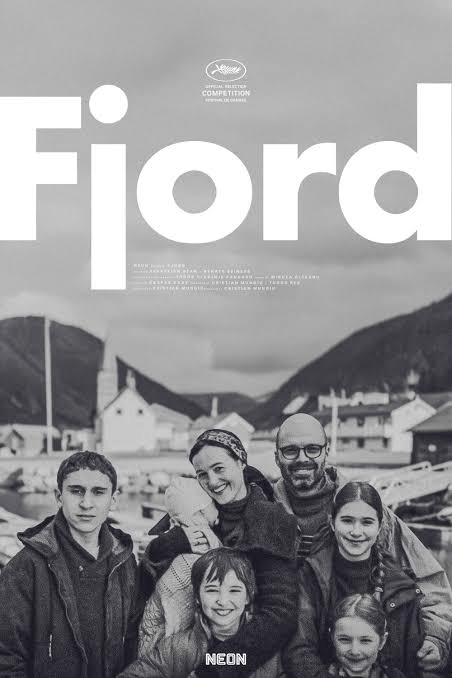
From Cristian Mungiu, arguably the most prominent director of the Romanian New Wave – a slow cinema movement of the late aughts experiencing a recent resurgence alongside a contradictory maximalism (see the films of Rada Jude, which strike a fascinating, paradoxical balance) – comes his second Palme d’Or winner, Fjord. Despite the film’s marketing exaggerating a slight balance to conventionally lurid social dramas, it retains the carefulness of observation and reconceptualization of structural convention essential to the New Wave. No more or less of a thriller than the significantly more contained 4 Months, 3 Weeks and 2 Days, Mungiu’s previous Palme winner from the heyday of the movement, Fjord’s ensemble of characters, more expansive than 4 Months’, are similarly figures of plot, both experiences more focused on a broad sociopolitical dialogue than details of personality or identity. Any tension is purely conceptual, the experience of Fjord in particular evoking Bresson. Although its narrative tensions may manifest incredible dread in relation to one’s own recollected or continued experiences, Mungiu’s storytelling is never titillating on its face.
That conceptual tension of his storytelling, however, is exquisitely founded. Fjord is a tense environment to be occupied by the audience, encircled and enclosed by grave subjects unremarked, on part of characters and filmmaker alike. Likewise, the Norwegian village where the story plays out is surrounded by mountains, the threat of avalanche a constant rumble, an elephant at the door, underlying and looming at once. The progressive villagers seem to ignore the possibility of danger, proceeding inside calmly as an avalanche plummets towards them: “You know the drill!” Given various internationally escalating controversies, at our place in history this broad metaphor seems uniquely apt to the conversation of mass migrations, just as the story’s themes of cultural clash and co-assimilation seem uniquely apt to the current reaction against ever-increasing globalism.
The two cultures concerned in Fjord are those of the traditionalist Romanian patriarch Mihai Gheorghiu and of the progressivist Norwegian villagers. The former culture, once insulated, is now submerged in the latter. The reason for the submersion is both economic and familial – Mihai has been hired for his skillset, needed in the village (ironically, the traditionalist is technically proficient, and the modern progressivist technically impotent), while his wife is returning to her birthplace, her parents and childhood homeland. Each culture thinks the other to be bigoted, brainwashed, “uncivilized”, quick to criticize by comparison with their own strengths yet blind to their own failings: a village teacher accuses the family of being “brainwashed” by religion while popping a Zyn under her lip in the middle of the school day. Accusations that one might be a sheep (‘Are you a sheep?’ ‘Are we sheep?’) are invoked by members of each culture to dissuade adherence to the other culture’s principles, never considering anyone sheep to their own.
The story begins with the Gheorghiu’s immigration to Norway, and it is not long before the family unit is disrupted. After Mihai’s daughter is noticed with bruises on her body, his children are mechanically redistributed to various foster families by remorseless Norwegian authorities, immediately certain he is guilty of abuse physical or otherwise. Decisions are made for the Gheorghiu children, starting with the move from Norway and continuing through the film’s final moments, “for their own good” – their lives are dictated by the lifestyles and prejudices of the adults around them. The adults of the story constantly make decisions on behalf of proximate children, often directly against those children’s wishes, and laude themselves for acting in the children’s “best interests”…these are characters callous to all but their own pride, and Mungiu thus makes plain the callousness and pride of all we recognize in them. Fjord’s is a story all about pride, ruled by pride. Yes, it concerns itself with assimilation and acceptance, corruption and bigotry, but in Mungiu’s context these subjects all run down to pride. Even the characters – figures of plot and perspective rather than individuals – all run down to the nature of their pride (the adults, anyway): it is what distinguishes them from one another, and the catalyst of every conflict. Such pride in one’s culture, in one’s values, in one’s practices, that others may be made to sacrifice their own.
Children’s humility in the face of all this pride, their ability to weather the course on which it sets their lives, is the most moving content of the film, the children of both the Gheorghiu family and the Norwegian village at the heart of its tragedy. Yet more than the most emotionally crucial characters, the children most honestly reflect the strengths and failings of each domestic culture. The traditionalist Gheorghiu children are sheltered and withdrawn, yet their behavior is often more logical and careful than their own parents; the daughter of their progressivist neighbors is without control over her emotions and vices, petulant, yet determined and overtly empathic. Both are deeply repressed; both accept in part and reject in part the respective cultures of their parents based on their respective co-assimilated value sets (for better or worse, these are children of a globalist generation who cannot be sheltered, and whose cultural environments must capitulate to one another); and both see a larger picture than any of the adult characters seem to: one of their future – emotional, relational, social, indeed cultural – and the courses it seems to have been set off on before their eyes.
A custody hearing eventually takes over the narrative, and evolves from a trial of the Gheorghiu parent’s treatment of their children to a trial of their assimilation. By its conclusion, evidently guilty of failure to assimilate by the village’s standards, they decide that they will all flee the country, and the children are again transported helplessly from vehicle to vehicle like Pesci in Casino. Throughout the trial, the question of the parent’s ability to raise children becomes a question of their traditional methods of parenting, and whether these have a place in a progressive society. However, the bruises on the Gheorghiu girl which initiated the entire investigation were caused by a dare from the progressive neighbors’ daughter – the girl jumped from a balcony on threat of being a traditionalist sheep. The blame placed against Mihai by the villagers, then, against traditionalism by progressivism, is circular. As the most outwardly bigoted character, a villager deeply averse to religion and Christianity, points out in the process of placing blame upon traditionalists, one mob is as dangerous as another. He misses the wisdom of his own observation: that he stands within the other of two conflicting mobs.
“SATAN SPEAKS THROUGH YOUR MOUTH“, reads a poster addressed from one mob to another. Does it matter which is which?

